Ermioni or Hermione?
4 September 2025 - 3:00pm
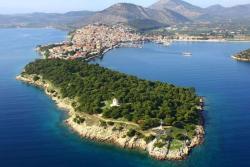 Ever wondered if it's Ermioni or Hermione? This historic Greek coastal village in today's Municipality of Ermionida, in the region of Argolida (Argolis) has been called different names throughout its long history. This is the story of present day Ermioni. The coastal town has a history stretching over 5,000 years, when it was originally founded by the mythical hero Ermionas, leader of the exiled ancient Dryopian tribe. The new settlement was dedicated to the Olympian messenger god, Hermes, giving the settlement its equivalent female name of Hermione. Dryopians were one of the aboriginal tribes of ancient Greece, with Herodotus putting their original settlements by Mount Oeta, near Thermopylae. Ancient Hermione developed into the Ermionis kingdom, its modern boundries being referred to as Ermionida.
Ancient Hermione was mentioned by Homer for its participation in the epic Trojan War, under the command of King Diomedes, sending three warships to join the massive Hellenic armada on its way to Troy, to bring back the beautiful Helen, queen of Sparta. In the 2nd century AD, Pausanias, a Greco-Roman traveller, compiled a very detailed description of the archaic town of Hermione.
Few people realise that a young woman called Hermione appears in Homer's epic poem The Odyssey, as well as some of Euripides' works, particularly Andromache, and carries some significance in ancient Greek mythology. Homer identifies Hermione as the only daughter of Menelaus, the Mycenaean king of Sparta, and his beautiful wife Helen. After Helen departs Sparta with Paris, prince of Troy, Menelaus is enraged and joins the war to reclaim his wife, today known as Helen of Troy. Nine-year-old Hermione is left in Sparta where she spends the next ten years being raised by her aunt Clytemnestra, wife of King Agamenmon, Menelaus' brother. Hermione's significance lies in how she represents the lasting impact of the Trojan War on the next generation.
Ancient Hermione originally developed on and around the present Bisti peninsula. This area was later fortified with a 'cyclopean' limestone wall, creating a defensive citadel similar to Mycenae and Tiryns, where all the original temples, palace and civic buildings were constructed. The main temple of Poseidon in the middle of the peninsula gave this citadel its ancient name of Poseideon.
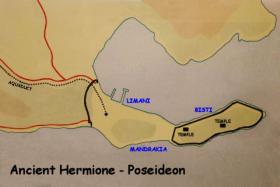
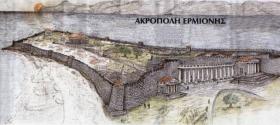
As ancient Hermione flourished and developed into the Ermionis kingdom, it controlled all the present Ermionida area which today includes Kranidi, Kilada, Porto Heli, Thermissia and Iliokastro. Hermione was allied to Sparta and Argos throughout the ancient, classical and Hellenistic periods. It supported the Mycenaean kings Agamenmon, Menelaus and Diomedes during the Trojan War and the Hellenic city-states during the two Persian Wars in the 5th century BC, sending 3 trireme warships and 300 heavy hoplite warriors plus infantry support troops to help defeat the Persian invaders at the battles of Salamis (480 BC) and Plataea (479 BC). Even during the 5th century BC Classical era, other Hellenic city-states still referred to the inhabitants of Hermione as Dryopians.
As ancient Hermione expanded, the local inhabitants began developing the eastern slope of Pronos Hill, today also referred to as the Hill of Pron, in the area known today as the Old Village. The ancient temple of Demeter Chthonia was built near the crest of the hill, today the 9th century Byzantine Metropolitan Church of Taxiarches (Archangels) stands on its foundations, still surrounded by the limestone walls. Eventually, coastal stone walls were constructed along all the Limani and Mandrakia waterfronts, enclosing the whole town with the Bisti citadel, giving the inhabitants of Hermione a better defence against frequent marauding pirate attacks.
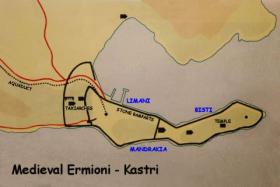
Ancient Hermione Medieval Kastri Modern Ermioni
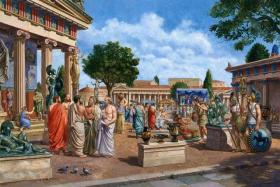
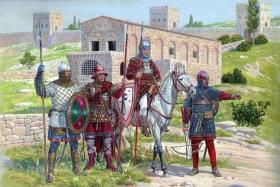
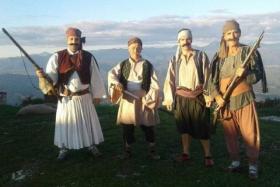
When the Frankish Crusaders took control of the Peloponnese during the early Medieval period, Hermione had its defensive walls enlarged with new bastions and fortified entrance gates constructed, giving it a look of a castle, as the coastal town acquired its Medieval name of Kastri. Churches and a new basilica replaced the old temples to the Olympian gods within the town, and a new castle outpost was constructed on Lizard rock near Thermissia, giving early warning of any naval attacks on the Kastri inhabitants.
The church of Aghia Ermioni was built in 1754 on the high central crest of Pronos Hill, over the foundations of the temple to Hera. Used for special occassions as local weddings and baptisms, this small church celebrates its annual name day on 4th September.
Kastri retained its name for more than 600 years, throughout the Frankish, Eastern Roman (Byzantine), Renaissance and Ottoman periods of history. Not until after the Greek War of Independence, 1821-1829, fought against the Turkish Ottoman Empire, that the newly-created Hellenic state renamed the town back to its ancient name of Hermione, with the modern Greek spelling of Ermioni.
Ancient Hermione - Poseideon (Bisti) Citadel - Medieval Kastri - Modern Ermioni
For a more comprehensive and further detailed History of Ermioni: click here. Greek name day of Hermione-Ermioni celebrated annually on 4th September.